
Background of Implementation
To enhance the comparability of sustainability-related financial information, the Authority released the Roadmap for Taiwan listed companies to align with IFRS Sustainability Disclosure Standards in August 2023. Under the roadmap, listed companies in Taiwan will adopt the IFRS Sustainability Disclosure Standards endorsed by the FSC in phases based on their market capitalization and disclose sustainability-related financial information in a dedicated section of their annual reports. Compared to sustainability reports, which primarily address the needs of a broad range of stakeholders, the IFRS Sustainability Disclosure Standards focus more specifically on sustainability-related issues that are relevant to investors. They emphasize how sustainability-related risks and opportunities faced by a business can have material effects on its financial position and performance.
Although TDCC is not a listed company, it plays a role as a securities and futures market infrastructure institution. In line with the aforementioned policy of the Authority to fully disclose sustainability-related information, TDCC took the lead in creating a dedicated section to sustainability-related financial information in its 2025 annual report, aiming to serve as a benchmark for promoting sustainable development among businesses and to drive market-wide improvement in the transparency of sustainability information.
Cross-Department Collaboration: Identify Material Sustainability Topics
To ensure a seamless alignment with the standards, TDCC Senior Executive Vice President Jing served as the project convener and mobilized all departments across the company to participate actively. From each functional perspective and in compliance with the IFRS Sustainability Disclosure Standards, team members thoroughly inventoried sustainability topics, deconstructed sustainability-related risks and opportunities, and evaluated both their likelihood of occurrence and financial impacts. Three material sustainability issues were identified: information security, customer relationships and customer rights protection, and climate change response measures. Accordingly, comprehensive response strategies were developed for these three material sustainability topics.
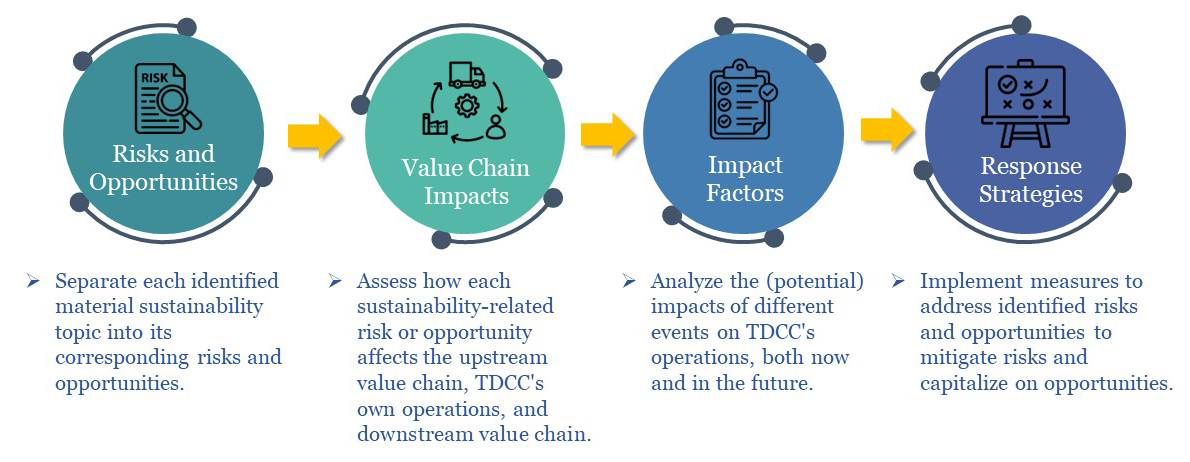
- Challenges in Calculating Sustainability-Related Financial Impacts
One of the greatest challenges in implementing the IFRS Sustainability Disclosure Standards is translating sustainability-related risks and opportunities into measurable financial figures. While traditional sustainability reports have primarily focused on qualitative disclosures, the IFRS Sustainability Disclosure Standards require companies to provide specific quantitative calculations and disclose both current-period and future financial impacts.
During the estimation of financial impacts, the following key items should be considered:
Identify relevant accounting items: The identified response strategies (such as employee training, engaging cybersecurity consultants, or procuring cybersecurity equipment) should be mapped to the relevant revenue and expense line items. If the expenditure is capitalized as a capital expenditure, the subsequent depreciation expense should also be taken into consideration.
Simultaneously Assess the Three Primary Financial Statements: When financial impacts are assessed, the analysis should not be limited to the Statement of Comprehensive Income. The impacts on the Statement of Financial Position and the Statement of Cash Flows should also be evaluated concurrently.
Review the Timing of Cash Flows: For each capital expenditure or operating expense, consideration should be given to whether payments are made in installments, prepaid, or remain payable at the end of the period. As the actual timing of cash receipts and payments may not coincide with the reporting period in which expenses are recognized, or capital expenditures are capitalized, the cross-period financial impacts should be estimated separately.
With respect to the disclosure of financial impact for future periods, specific figures shall be estimated in the short term based on the budget prepared for the upcoming fiscal year. For the medium-term to long-term impact, where quantification is difficult, a qualitative description may be provided initially to comply with the requirements of the standard.
Inventorying Investment and Financed Carbon Emissions to Deepen Climate Risk Management
TDCC has proactively established a process for inventorying and quantifying carbon emissions associated with investment and financing activities; the company has successfully overcome challenges such as the complexity of asset classification and the difficulty of collecting carbon emissions data from investees. To ensure the accuracy and compliance of the calculation results, TDCC has made the following efforts in its implementation:
Establishing the inventory boundary: The "operational control approach" was adopted to define the inventory boundary, and in accordance with PCAF (Partnership for Carbon Accounting Financials) standards, long-term investments were incorporated into the calculation.
Calculating attribution factors: Attribution factors were calculated for different asset classes, including equity investments, corporate bonds, and sovereign bonds, to allocate financed emissions reasonably.
Applying a tiered approach to address data gaps: In response to the challenge of lacking carbon emissions data for certain unlisted investees, TDCC applied reasonable estimation methods in accordance with PCAF standards, successfully completing the inventory of Scope 3 financed emissions.
Through the inventory process described above, TDCC has gained a clear understanding of its carbon emissions profile. Going forward, TDCC will continue to track developments in the PCAF methodology to further enhance overall data quality.
Balancing Operational Resilience and Sustainable Transformation
Based on a comprehensive assessment, TDCC's expenditures in response to the three material sustainability issues have all remained within a stable and manageable range, with no material impact on its overall financial position. At the same time, the target of reaching a scale of ten billion in sustainable finance product investments was achieved ahead of schedule in 2026. Reflecting on the process of creating the IFRS sustainability dedicated section, cross-departmental collaboration successfully translated sustainability risks and opportunities into quantifiable financial data and actionable strategies.
Looking ahead, as international sustainability disclosure standards continue to evolve, and the PCAF methodology becomes increasingly refined, TDCC will continue to monitor developments in these standards while enhancing its internal sustainability management mechanisms and data quality. These concrete practical outcomes fully demonstrate TDCC's continued efforts. While strengthening the operational resilience of financial infrastructure, TDCC remains firmly committed to leading the financial market in advancing sustainable development.
