TDCC Joins Industry Partners on U.S. Visit Exploring Trends in Extended-Hours U.S. Equity Trading and Securities Tokenization
2026/08/18
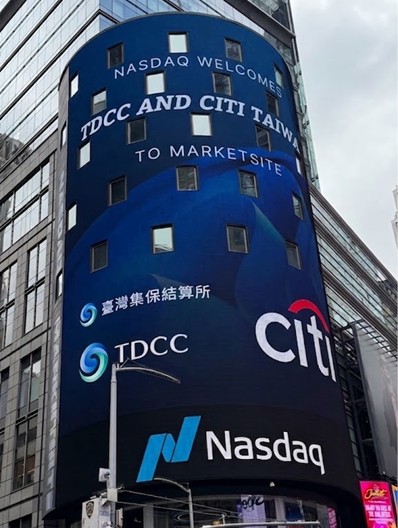
In response to the continued growth in Taiwanese investors’ demand for overseas investment, Taiwan Depository & Clearing Corporation (TDCC) recently accepted an invitation from Citi to lead a delegation to the United States. Headed by TDCC Chairman Bing-Huei Lin, the delegation included representatives from domestic securities firms offering sub-brokerage services, including Fubon Securities and SinoPac Securities. The delegation visited Citi, the New York Stock Exchange (NYSE), Intercontinental Exchange (ICE), Nasdaq, and the Depository Trust & Clearing Corporation (DTCC), with a view to deepening international exchanges on extended-hours U.S. equity trading and asset tokenization.
Drawing on Taiwan’s market framework, investor profile, and industry needs, the delegation held discussions with its U.S. counterparts on key topics including extended-hours trading, clearing and settlement, corporate actions, and securities tokenization. Throughout the visit, Ambassador Tom Chih-Chiang Lee of the Taipei Economic and Cultural Office in New York and the Financial Supervisory Commission Representative Office in New York provided strong support and shared their observations on developments in U.S. financial markets and regulatory policy.
NYSE and Nasdaq noted that Asian retail investors have become an important driver of extended-hours trading in U.S. equities. U.S. exchanges are moving toward a 23-hours-a-day, five-days-a-week (23/5) trading model, with only a one-hour window reserved each day for system maintenance, corporate action processing, and trade-date rollover. Meanwhile, the National Securities Clearing Corporation (NSCC) has already moved to 24/5 operations, enabling trades executed during Asian market hours to enter central clearing earlier.
With respect to the tokenization of securities and real-world assets (RWAs), both NYSE and DTCC emphasized that asset tokenization does not imply the disappearance of existing market intermediaries. The U.S. approach builds on the existing securities regulatory framework and market infrastructure, allowing traditional securities and their on-chain representations to maintain a one-to-one correspondence while preserving security identifiers and the underlying economic rights. DTCC has also strengthened its tokenization and blockchain capabilities through its acquisition of Securrency and has received authorization from the U.S. Securities and Exchange Commission (SEC) for a three-year pilot period, while continuing to pursue a multi-chain strategy and assess cross-chain interoperability services.
TDCC Chairman Bing-Huei Lin noted that extending trading hours is not simply a matter of providing investors with more time to trade. It also requires seamless and secure coordination across clearing, settlement, custody, and account administration. TDCC will continue to connect with international market infrastructures, global custodian banks, and domestic securities firms to strengthen cross-time-zone operations and risk management.
Chairman Lin further noted that even as blockchain technology is introduced into the trading process, core post-trade functions—including centralized custody, asset safeguarding, entitlement allocation, and investor services—will remain indispensable. TDCC will therefore seek to integrate digital securities into its existing frameworks for cross-border custody, account administration, corporate actions, and regulatory compliance, striking an optimal balance between innovation and security.
Chairman Lin emphasized that the visit has strengthened TDCC’s communication channels with U.S. exchanges, clearing and depository institutions, global custodian banks, and data service providers. Going forward, TDCC will continue to deepen international cooperation and enhance its cross-border custody and post-trade services, helping safeguard the security and rights of investors engaging in cross-border transactions. These efforts will also support the Financial Supervisory Commission’s vision of fostering greater trust in finance and advancing the objectives of its Guidelines for the Financial Industry to Deepen Social Trust and Giving Back.