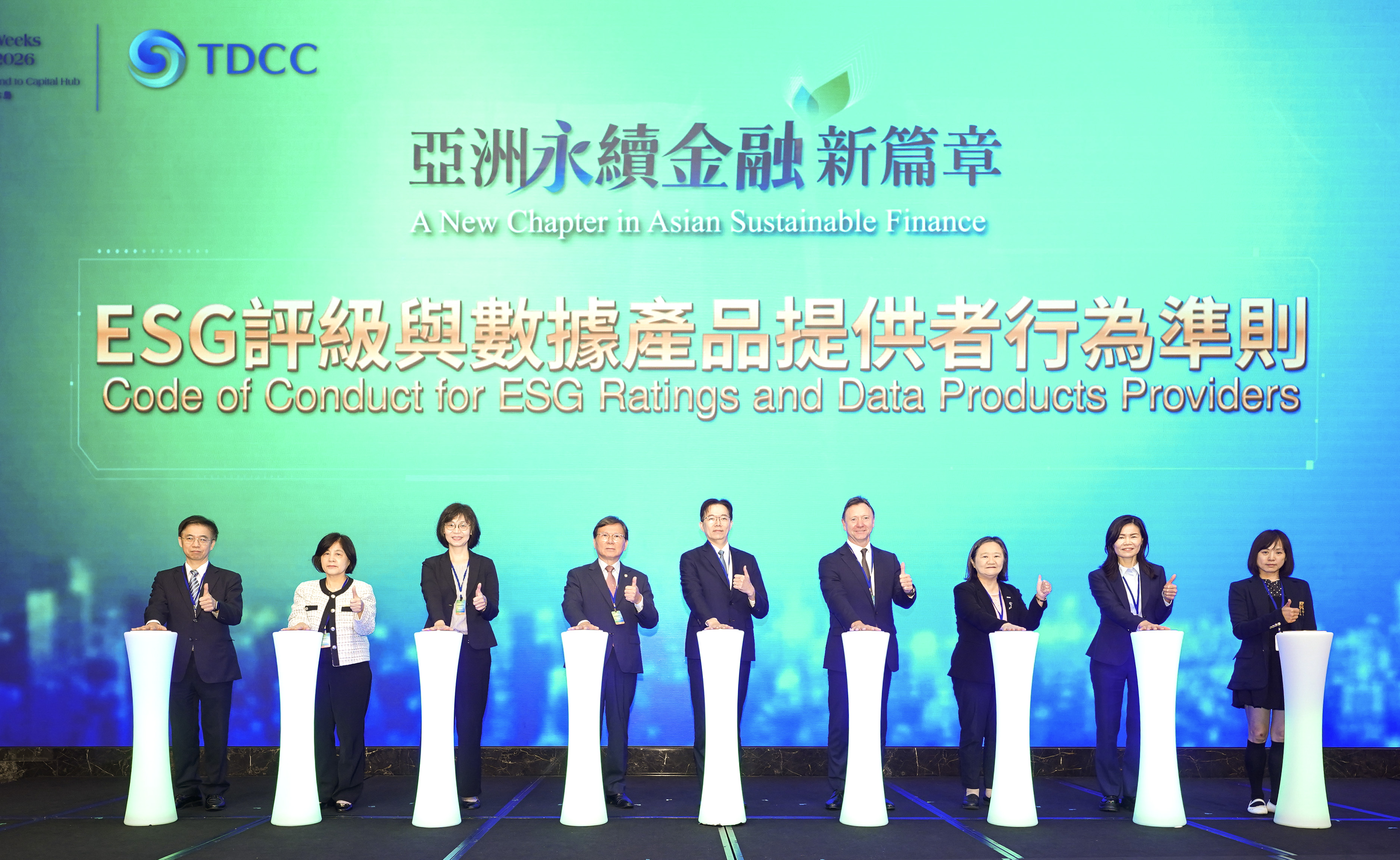
TDCC Hosts "A New Chapter for Asian Sustainable Finance" Forum, Spotlighting Overseas ESG Ratings and Sustainable Commercial Paper to Complete Taiwan's Green Finance Landscape
2026/11/06
During 2026 Taiwan Weeks, Taiwan Depository & Clearing Corporation (TDCC) held the international forum "A New Chapter for Asian Sustainable Finance" on November 6. The forum focused on two core themes: "How Taiwan's Listed Companies Should Respond to the New Era of ESG Ratings" and "Innovative Practices in Sustainable Commercial Paper." Bringing together regulators, domestic and international financial institutions, issuers, and experts in the oversight of ESG ratings, the forum offered an in-depth look at global sustainability trends, with the aim of helping Taiwanese companies enhance the quality of their disclosures and injecting fresh momentum into sustainable finance in Taiwan's capital market.
The forum opened with a keynote address by Bryan Pascoe, Chief Executive of the International Capital Market Association (ICMA), on "The Global Perspective on ESG Ratings and Data Products." The first panel, titled "Lessons from Overseas: How Should Taiwan's Listed Companies Respond to the New Era of ESG Ratings?", was moderated by Jeffrey R. Williams, Board Member of the Asian Corporate Governance Association (ACGA). Panelists included Will Goodhart, Executive Director of the Future of Sustainable Data Alliance (FoSDA); Stanley Soosur, Head of APAC at Glass Lewis; and Michael Yam, Head of Government and Regulatory Affairs, Asia Pacific, at MSCI.
Opening the discussion, the moderator outlined the core issues: Taiwanese companies continue to face challenges arising from inconsistent rating scores, sustainability efforts that go unrecognized, and questions over whether the underlying data can be verified. The three panelists shared their experience on how rating agencies collect data, and on the ESG data governance, internal controls, and communication mechanisms with rating agencies that companies should put in place. Turning to whether international disclosure standards can reduce rating divergence, and whether rating methodologies should pursue consistency or preserve diversity, the panelists discussed international standards such as the ISSB standards and the ESRS. They also shared insights on emerging trends in how companies are responding to AI and data use, generating lively engagement from the audience.
To close the session, each panelist offered a recommendation on "the one thing Taiwan's listed companies should do within the next year." They expressed the hope that Taiwanese listed companies will keep pace with international ESG rating and disclosure trends, strengthen data governance, and communicate effectively with rating agencies, so that their sustainability efforts can be fully and accurately recognized. The second panel, titled "What's More: Completing the Green Finance Landscape – Innovative Practices in Sustainable Commercial Paper and New Investment and Financing Opportunities," explored the challenges and future development of Taiwan's first-of-its-kind sustainable commercial paper framework. Moderated by Hsu Shuang-Chuan, Secretary General of the R.O.C. Bills Finance Association, the panel featured Chen Shih-Yi, President of Mega Bills Finance Corporation.; Kan Mei-Chu, President of International Bills Finance Corporation; Lu Chia-Yin, Financial Manager of Run Long Construction Corporation; Ricco Zhang, Senior Director, Asia Pacific, ICMA; and Aaron Wei, Head of Asia Pacific, Sustainable Fitch, who shared their insights and exchanged views on the topic.
Speaking from the perspectives of underwriters, institutional investors, and issuers, the panelists walked through the full practical process, from a company setting its sustainability goals and preparing a sustainability plan in line with international standards, to obtaining a external review report and issuing sustainable commercial paper. They also offered valuable insights on international developments and the challenges ahead, and spoke highly of the rigorous review process and the innovative experience behind Taiwan's sustainable commercial paper. In closing, the panelists expressed hope that, through collaboration among all stakeholders and continued policy support, the market will attract more small and medium-sized enterprises (SMEs) and build a green finance environment that benefits businesses of all sizes, a message that resonated strongly with the audience.
TDCC stated that, as global sustainability disclosure requirements become increasingly stringent and green financial products continue to innovate, TDCC will continue to serve as a key hub of the capital market. In line with the Financial Supervisory Commission's (FSC) policy guidance on sustainable development, TDCC will further strengthen its digital sustainability service platforms and multi-stakeholder cooperation mechanisms, helping Taiwan's listed companies and financial institutions align with international standards.